
Dolgan ornamentation on traditional clothes
According to Dolgan, clothes without a soul are clothes without ornaments. Therefore, ornaments on clothes are called “ichchite” (from the verb “ichchilee” – to spiritualize). And simple clothes without jewelry – “ichchite huok". Each ornament carries the task of protecting from evil spirits, words and thoughts. It is applied with a specific purpose, its character reflects the Dolgan worldview, their faith in the sacred. Signs and symbols are applied not only to clothes, but also as a ritual purpose on the tire of the plague, household items also do not remain without ornaments.
It is believed that when you sew ornaments, they should be applied with bright thoughts and feelings, as we know, many peoples believe in the power of words, so sometimes craftswomen apply ornaments by singing, fixing additional energy to them. Also, to maintain a bright mood at work, the environment and the time of creating patterns are important.
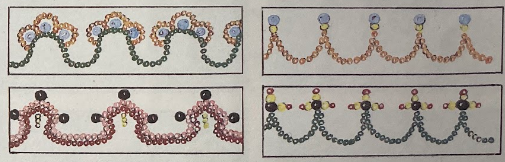
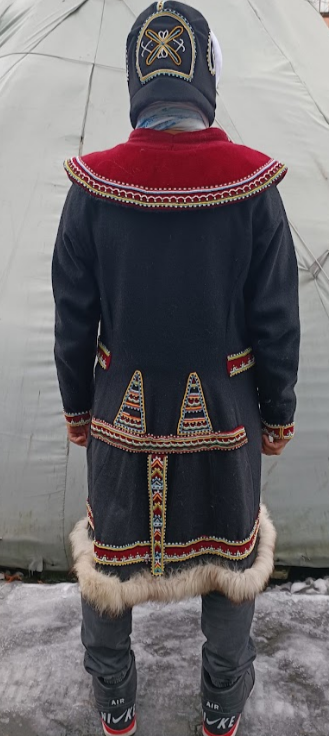
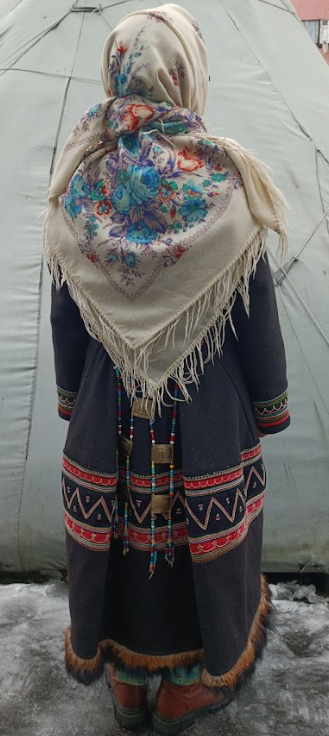
Nowadays, Dolgan clothing is decorated mainly with beads, without which it is difficult to imagine traditional Dolgan clothing.
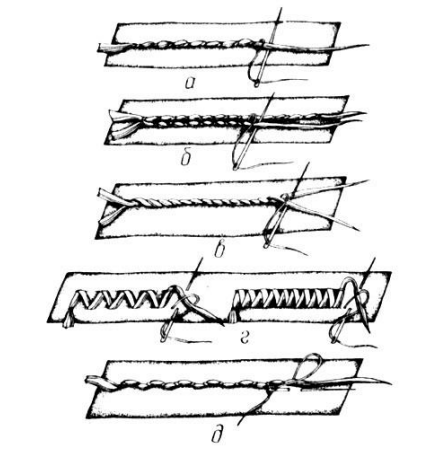
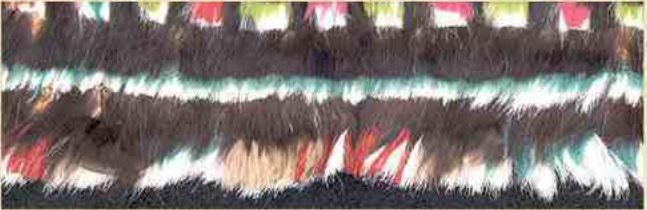
Before beads, the neck hair of a deer was colored with a certain (more often green, pink and yellow) color for covering ornaments. This neck hair was carefully taken from the deer's beard, it was important to pull it out by the roots. Then the hair was gathered into a bun, connecting and tying them into a single knot in the root area, since the root is stronger than the hair. The hair was used mainly as an edging strip on ornaments and between straight strips of fabric.
The paint was obtained from natural materials, such paint is resistant. To obtain the green color, grass was used, the red color was extracted from a red stone with a soft structure, the Dolgans call it “hoho taas" (ochre). The technology looked like this: the stone was crushed to a powder state, then fat and water were added to it, then boiled in a boiler. The fat was a binder for the production of paint. The yellow color is obtained from yellow lichen, by the same method of boiling, it could serve as a paint. A black color came out from the boiler's carbon deposits. Unfortunately, the ancient technology of sewing in this way has been replaced by the bead technique [3].
The origin, distribution and structure of Dolgan ornaments have not been fully studied, but researchers recognize the Tunguska-Yakut layer of Dolgan ornaments.
The Dolgan ornament has a lot in common, first of all, with the artistic traditions of the northern Yakut reindeer herders, with whom the Dolgans are known to have an ethnocultural kinship. Ethnocultural borrowings occur mainly among those peoples whose forms of economy are most similar. In this regard, Dolgans and Northern Yakut reindeer herders have a lot in common. The culture of the Yakut reindeer herders, which has developed very distinctive artistic traditions, differs somewhat from the culture of the southern Yakut cattle breeders in the system of ornamental motifs.
According to Vasiliy Ivanovich Batagay, head of the Department of Decorative, Applied and Fine Arts at the Taimyr House of Folk Art, who studied Dolgan traditional clothing during expeditions, the village of Volochanka (Taimyr Dolgan-Nenetsky district, Krasnoyarsk Territory) is the cradle of the richly ornamented Dolgan park, which is due to the fact that skilled craftsmen worked there and Khatanga passed through Volochanka. a tract where there was an active trade in beads, cloth, and thread [1].
As A.I. Savvinov's field research shows in Taimyr and in a number of northern regions of Yakutia, Dolgans and northern Yakuts use typologically similar artistic motifs. In this regard, it should be noted that the features of Dolgan ornament should be considered primarily in close connection with the North Yakut ornamental traditions, which have not yet been considered separately, their typological and stylistic features have not been studied [4].
S.V. Ivanov considered the Dolgan ornament in the system of artistic traditions of the Tungusic-speaking peoples of Siberia, and this approach was not accidental. Their typological similarities are explained not only by their economic, cultural and territorial community, but also by the influence of an ethnogenetic factor. The presence of such obvious Even-Evenk motifs in the Dolgan ornamental traditions is primarily due to the presence of a significant Tungusic component in their ethnic composition [2].
The following ornaments and their meanings are presented in the book “Ornament – the language of ancestors”, the authors of which are employees of the Taimyr House of Folk Art: V.I. Batagai, V.N. Popova, S.S. Aksenova, S.M. Kudryakova, A.P. Yarotskaya, R.P. Yaptune [3].
According to Dolgan beliefs, a crevice between mountains is a “portal to the lower world”, it is from there that evil spirits come, through a crevice in mountain, the hero Boskhoy Durantay entered the lower world in the epic Toyon Joldo. If the “Arday” is not complemented with another ornament – “Onguu” (Оҥуу), then this image – a crevice or emptiness – carries negative energy in spiritual culture. This ornament is sewn in different techniques: the first is called “Hinnyelekh arbagas arday” (Һинньэлээх арбагас ардай) – a broken line in the technique of sewing with deer's neck hair; the second is “Torgo arday” (Торго ардай) – colored fabric and threads; the third is “Oguruo arday" (Огуруо ардай) – beaded; The fourth is “Tirii kybyty arday" (Тирии кыбытыы ардай), a fur applique.
"Onguu" is used as a detail of ”Arday“, this ornament in the form of a triangle or a heart is located between the zigzags of ”Arday" as an addition, it is applied as a talisman. "Onguu” symbolizes the guard of three heroes, characters of the heroic epic “Boscondoy”, who protect the middle world from evil spirits.
“Tumus" (Тумус), or “Tynyrak" (Тыҥырак) - cape, or nail. The Dolgans' meaning of “Tumus” (a cape) is explained by the fact that, according to their ideas, the universe includes nine capes, such an idea of structure of the universe is reflected in one of the poems by Ogdo Aksenova, a Dolgan poetess.
In epic tales, one can enter the upper world through holes of the sacred “Chirkan” (Чиркан) - a crushing trap for catching small fur-bearing animals. There are two heroes standing guard over the two capes. This ornament has three types: the first is in the form of connected semicircles, the second has a looped shape, and the third is in the form of overlapping semicircles with chopped loops. This pattern is found on the ornamental stitching of women's clothing, on a belt, a pouch, as well as on a headdress and shoes.
When embroidering “Tynyrak”, the oval of the thumb nail is taken as a sample. It is embroidered with small beads, hemlock deer hair and colored threads.
The "Irbii” (Ирбии) ornament. Dolgans, when they saw blooming tundra or autumn landscape, said: “Hirbit dirbiyaer” – the earth is full of different colors, so the word “Irbii” comes from the name of mottled tundra. Therefore, such an ornament is characterized by a jerky line, a dotted line, a narrow ribbed stripe, and a herringbone stripe.
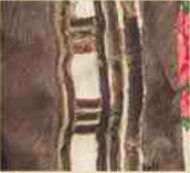
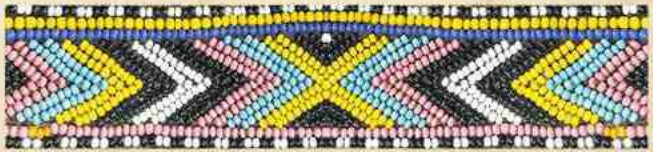
The second value is the spine. In Dolgan mythology and belief, it can be traced that the spine is interpreted as a talisman. According to some shamans, the crosspiece of the tambourine depicts the cruciform vertebral bone of a giant pike (Sakanaana), and the earth supposedly rests in the middle of this bone. The pike is highly revered in shamanism. There is also a belief that the seventh cervical vertebra of a wild deer has the power of a talisman: illness and bad thoughts cannot pass through the opening of the spinal disc. This strip serves as an edging line or is located in the center of the ornament. It is sewn with white and black threads or beads. So this colorful stripe plays a major role in sewing any ornament in Dolgan clothes, protecting the entire ornamental composition.
"Huturgu" (Һутургу) - a simple, direct, endless one. Striped ornament in the form of straight lines. This name is given to clothing with a straight stripe pattern of the same name. This ornament resembles the tracks of a sled in the snow, extending far beyond the horizon. In the “huturgu” parks, you can see this ornament. It is sewn from strips of fabric twisted into a tube and sewn with a secret seam.
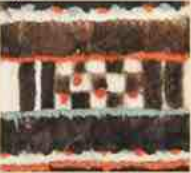
The "Tolbon" ornament. It is executed in the technique of fur mosaic in a combination of dark and light pieces of fur. Among the Dolgans the spotted deer is called “bugdii". He is considered sacred – only he could carry family idols or icons. Spots in the Dolgan culture play the role of sacred signs of the good gods of Ayii. During the Yakut rite, “Algys” the algyschit (the one who rules the rite) stands on a fur rug called a “Tolbon.” Black and white squares symbolize the intertwining and staggered intersection of black and white stripes in a person's life.
There are several variants of this ornament:
а) Kyp tolbon (Кып толбон). The ornament is sewn with red rectangular inserts bordered by a beaded ornament “Ilim karaga" – a grid cell. Dolgans associate the red color with the sun, and red pieces of matter were attached to the patient's sore spot. It was believed that they were capable of healing wounds.
б) Hokkor tolbon (Һоккор толбон). In the Dolgan dictionary, the word “hokkor" is translated as “one-eyed". Epic tales describe one-eyed creatures living in a parallel world.
в) Haakymat tolbon (Һаакымат толбон). An ornament in the form of a chessboard. It is found only on the seam of a women's fur parka. At the end of the twentieth century, Dolgan women began to sew this ornament from fabric and beads. It is usually sewn on cloth parks.
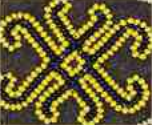
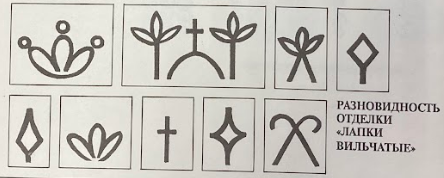
"Harbannyak" (Һарбанньак) – a hand, a fringe, a shoulder blade of a deer horn. An ornament consisting of peak-shaped or cross-shaped projections connected by rounded or straight bases. "Harbagar/arbagar“ (Һарбагар/арбагар) is branched, another word ”harbai“ (һарбай) translates as "spread fingers". In the Dolgan dialect, ”takbak“ (такбак) or ”harbak“ (һарбак) translates as ”five fingers together." The branched antlers of the deer, according to the Dolgan beliefs, protected them from illness and misfortune. They were directed in the direction from which the trouble came. A disease or an evil spirit cannot pass through the sharp tips of the horns, which cause pain to hostile spirits. Deer antlers were used in rituals, placed on the grave and on the roof of the house, thereby confirming their protective function.
There are several variants of the ornament, depending on the nature of the pattern:
а) Iegii harbannyak (Иэгии һарбанньак) – has a rounded base ("ieger" (иэгэр) – bends). This ornament is the parent of the “harbannak" ornament.
б) Olorduu harbannyak (Олордуу һарбанньак) – planted on a corner, has a straight base. This ornament is loved by craftswomen, as it is sewn easily.
в) Toguruk harbannyak (Төгүрүк һарбанньак) – an arc-shaped ornament. It is given to professional craftswomen because of the difficulty of sewing an arched shape.
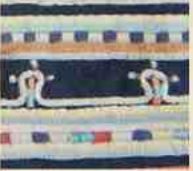
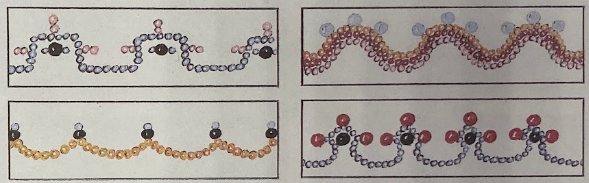
г) Kulgaak harbannyak (Кулгаак һарбанньак) – a pattern with ears. Black and white beads or a thread in the form of an ancient earring are sewn on the tips of the peak-shaped protrusions. Before the advent of silver Yakut earrings, Dolgans wore earrings made of beads. The ear symbolizes good luck. It's not for nothing that reindeer herders cut out the tips of deer ears and put them in pouches, thereby attracting good luck.
e) Toloru harbannyak (Толору һарбанньак) – filled inside. The interior of this ornament was filled with a vertical mottled stripe or a cross, filling the void. According to the beliefs of Dolgan, into the void. During a person's prolonged absence, sharp objects were placed on his bed so that the spirit of Ichchi would not settle in it.
Variants of the “harbannyak” border pattern
"Tanalay" (Таҥалай) – a palate. Ribbed ornament in the form of a herringbone, a palate, is one of its most archaic meanings, found in various phonetic variants in many Turkic languages. In addition, in the old days, the Yakuts used to call a women's wedding fur coat with short sleeves that did not reach the elbows. The ornament apparently got its name from the nature of the drawing. It is sewn on shoes and men's beaded belts. For example, the "Tanalay" ornament on shoes is sewn on the side inserts, and the ornament is always directed upwards.
It can be found on hair holders. According to the canons of Dolgan embroidery, it is sewn only on certain items of clothing – on shoes or a park. A gross mistake is the embroidery of the "Tanalay" ornament on the headdress.
Why is this ornament so called by Dolgans, and why is it called "a palate"? If you run your tongue across the palate, there is a feeling of tickliness, to some extent - a feeling of ribbing, although this version can not be considered as the basis for creating this ornament. According to another version, the Tanalay on shoes is directed upward, not downward, because it is associated with upward movement to the upper world, where the good deities of Ayii live.
"Hige" (Һигэ) – a branch of a willow, an oblique snowfall. A corded ornament, a narrow stripe consisting of alternating white and black, obliquely arranged stripes. This ornament symbolizes a snowfall with wind leaning from a wind to a branch of a bush or tree. "hiik kaar" (һиик каар) – snowfall with wind, "hekte" (һэктэ) – duck branch, "mas turuuta", "mas tyryta bogkoybut" (мас туруута, мас тырыта бокгойбут) - duck branch bent.
A branch or bush symbolizes a part of the sacred tree "Turuu mas" among Dolgans. Upon arrival at the new place, the Dolgan women performed the "Dtlbtrge" ceremony, a gift to the spirits of nature. They tied a garland of colored ribbons to a branch, asking the spirit of the owner of the area for permission to stay in this territory.
Dolgans performed the "Alastyr" or "Benevolence" purification rite with the help of a branch of juniper or rosemary.
"Ilim karaga" (Илим карага) - a cell of the network. Diamond-shaped ornament. This ornament is found on cuffs and in ornamental inserts. The pattern symbolizes nets for catching fish and birds during molting. Fishing gear is an integral part of the fishing activities of the Northerners. A cell is an opening. Dolgans believe that phenomena like souls or spirits can pass through round holes in objects, so the holes play a positive and negative role.
"Kutuyak kaamyta" (Кутуйак каамыыта) - a mouse step. A small pattern in the form of small loops connected to each other. Another variant of this type of ornament is sewn from deer hair from small rectangles connected in a checkerboard pattern. It is found only on the ornamental insert of the pack bag.
When the sun just appears on the horizon, Dolgans say: "A mouse carries the Sun on the tip of its nose, the Sun rises with mouse steps." Dolgans believe that the sun goes to the lower world in winter. And only a little mouse descends to the lower world every year to raise the sun's disk to our middle world. The mouse in the Dolgan culture plays the role of a guide to the lower world. Thus, the craftsmen embroider this ornament as a reminder of the birth of the sun and the endless journey of the mouse through time.
“Kotor ataga" (Көтөр атага) - a bird's foot. Three-branched ornamental figure of various modifications. This type is found on the ornamental insert of a pack bag, as well as on the pocket of a men's festive parka.
Why did Dolgan craftswomen decorate their pack bags with this ornament? The bird's foot symbolized the messengers of the upper gods. And only birds, according to Dolgan beliefs, can fly to the ninth tier, where the good gods of Ayii live. Dolgans believe that small birds (dalbaki, haltai) are the souls of children. Killing such birds is considered a great sin. A bird's foot drives away evil spirits. Under Argish, women put the most expensive things in an ornamental pack bag. To prevent the bag from disappearing during the move, it was lined with various ornaments, giving them the function of a talisman. This was how women protected their possessions.
"Yrbyy" (Ырбыы) - a narrow strip. A narrow line in the form of straight contrasting inserts of leather and fur on the ornamented part of the thing. E.K. Pekarsky defines this word as follows: a strip on a plane dividing it into two parts. According to another version, "yrbyy" translates as "a dark narrow strip of water between an ice and a shore." This strip for fishermen means that it is time to catch the first fish. Throughout the camp, people rush to the riverbank, where they stay all day, and perform a rite of feeding the spirit of the Mistress of Water. The first fish caught this year is being tasted. This ornament is associated with the event of the first fishing, when all the inhabitants of the camp merge into one friendly family.
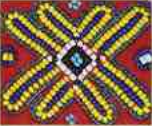
Uhuor (Уһуор) - a rosette pattern. The ornament is in the form of a four-branched rosette. This ornament is found on the occipital part of a man's bonnet. It is also called "tunnuk" – the window. The ornament on the back of the cap has not been deciphered. There is an assumption that the women sewed the occipital part of the hood for a talisman from the back. After all, this part of the head, according to Dolgan beliefs, was considered the first container of the "kut" – the human soul at birth. Here is what M.I. Popova writes about this: "The soft crown on the baby's head was considered as the place of entry of the kut, the good spirit. The heart was considered the dwelling place of the soul. It seemed that there were three souls in a person: one lived in the back of the head and could suddenly disappear. The body contained a second soul. This soul wasn't that mobile. The third soul was in the back. She would get away from fright, then the person would become "omurek," i.e., timid."
“Dukaa" (Дукаа), “Ytyrga" (Ытырга), “Kaas ataga" (Каас атага) – a little chum, an earring, a goose's paw. The ornament is in form of a triangle, three-branched in the upper part. "Dukaa" is a chum–like ornament found on a woman's headdress. A 'chum' is a dwelling where only a woman is the mistress, this is her little world. A woman with children is installing the chum. Only Mistress of a chum feeds the fire. Thus, this ornament symbolizes and protects a woman in her difficult home activity.
“Ytyrga" - an earring. This item protects a woman's ears: sounds and words reaching the owner must pass through the earring. All the bad things are not overlooked.
“Kurpaasky ataga" - a partridge's foot. This bird winters in the north, it symbolizes having many children. In summer, the plumage of the partridge changes to a mottled outfit, thereby making this bird invisible.
"Kaas ataga" - a goose's paw. Goose is considered the favorite food of the Mother Universe. When the Norilsk dolgans saw off the geese in autumn, they shouted after them: "Don't let yourself be caught, sitting at the opening of the clouds." But for some dolgans, the goose symbolizes "kut", that is, the soul of a person.
All these names of a single ornament associated with a bird, a dwelling, and an ornament are an integral part of the female cult.
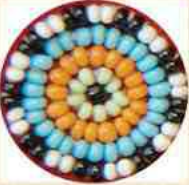
“Karak” (Карак), “Kun" (Күн), “Muos onnuta" (Муос оннута) – the eye, the Sun, the base of the horn. The ornament is in the form of a colored circle. It is found on a man's hat and is located in its upper part. The "Karak" (eye) pattern gives the wearer a keen eye so that the hunter can hit the prey with one shot. The ornament consists of many colored circles.
The second interpretation of this ornament is "Kun" (the Sun). The cult of the Sun among the Dolgans is in an important place. Every spring, a sacred ceremony of meeting the Sun is held, which is called the "Big Day" meeting. At this time, relatives gather and hold weddings, as well as sports competitions. According to Dolgan beliefs, the Sun is the daughter of the bright deity Ayii. In honor of the arrival of the Sun in the middle world, the Dolgans danced the ritual dance "Step with a bow", thereby thanking the Sun.
The third interpretation of this ornament is "Muos onnuta" (the base of a deer horn). In the Dolgan cult, the stag's horn plays the role of a formidable weapon in the fight against evil spirits. During epidemics, Dolgans placed their horns with the tip in the direction from which the disease came. Thus, they protected the camp from disease. Round ornaments can be found on various objects: metal parts of a woman's staff, wooden bows of deer saddles, bone deer cheek pads.
“Kurpasky ataga" - a partridge's foot. This ornament is found on women's bags for needlework and pouches, where all sorts of small things are stored. The partridge as a bird does not represent any symbolism among the Dolgans, but its paw bears the image of a bird as a messenger of the upper world.
From another point of view, the image symbolizes the sacred tree – "Turuu mas". The central element of the ornament is depicted in the form of a tree, and the two lateral rounded curls can be defined as hills. The epic tale "Brother and Sister" describes a sacred hitching post made of a "Serge" tree, which is surrounded on two sides by majestic hills. Thus, this dolgan ornament symbolizes the sacred tree "Turuu mas".
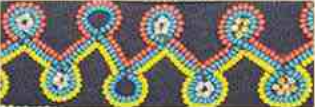
“Toronun, beah turku" – harness on a sleigh. This ornament is zigzagged. It can have either loops or vertical stripes on the folds. The craftswomen looked at this type of ornament on men's sleds. The harness is located on the sides of the sled. The function of this cord harness is to strengthen the rigidity of the sled, which is necessary when riding on the tundra. This means that the presence of this ornament on clothes helps to give rigidity and resilience to a person in a difficult life situation.
“Tarbuck" - an animal's paw. This ornament is found on men's parkas and is located on pockets. It symbolizes an animal's paw with claws. For example, Dolgans made amulets from the paws of a rabbit. Images of the paws of predatory animals are found on the shamanic costume. The image of this ornament is intimidating.
Bear, wolf and wolverine have claws, and they defend themselves with them. On "Gurumii" women's shoes, the upper part is sewn from wolf camus. A wolf's claw is left on the knee part of the shoe as a symbol of a talisman. Dolgan's bear paw was hung in the house as a talisman to ward off evil spirits.
“Kulgaak" – an ear. An ornament in the form of an auricle. It is found on a man's headdress and is located at ear level. The Kulgaak pattern gives the wearer a keen ear. Dolgans believe that animals and birds understand human speech. The ornament consists of many colored stripes.
“Yt tiihe" – dog teeth. This ornament consists of small rectangles connected in a checkerboard pattern. Some animals treat people benevolently.
Thus, Dolgan's closest human friends were considered to be a domestic deer and a dog. A "four-eyed" dog, that is, a dog with white spots, was considered to ward off evil spirits. When she barked in her sleep, she warned her owners about the upcoming attack of wolves on deer. Some hunters have an ehekeen, a red, mottled, or gray dog that brings them luck. They don't take her hunting with them, but before setting off, they tie colored pieces of cloth to her fur and fumigate her with fat, asking her to give good luck – to give wild deer.
"Elden" – the northern Lights. The central blue stripe on the canvas is called "Elden". According to Dolgan beliefs, when the northern lights come very close to the earth, it can take a person with it. Once upon a time, the Dolgans had a ritual dance called the Northern Lights. The elders said that when the northern lights appear in the sky, they swallow up the stars. It can be found in most cases in the parks of the elderly.
“Erien" is an alternation of dark and light spots, dotted line. The name of this element is found in the booklet "Ornaments of the peoples of Taimyr". A.A. Suzdalova, a connoisseur of Dolgan culture, explains the purpose of the "Erien uesteek oyuuta" ornament as follows: if this element is located in the center of the ornamental composition, then its name changes to "Eus" (stomach). The element "Erien" is present in all ornaments, it plays a major role in the decoration of Dolgan clothes.
Dolgan ornamentation is an extremely vivid artistic phenomenon with a stable tradition, thanks to the masters of folk art, spirituality is still present on traditional clothes. The Dolgans have absorbed the influences of various Tungusic and Turkic-speaking peoples and the Dolgan cultural code is preserved on them: their idea of the world, wishes, charms, the history of man and even the world. Therefore, knowledge about the purpose and place of the ornament on clothes is extremely valuable.
Sources:
- Dolgan clothes and ornaments, basic rituals and Taimyr Dolgans. Batagay Vasiliy. URL: https://youtu.be/L5iRvl60wpw?si=Pim7Z7SYhw6IeiN2
- Ivanov S.V. The ornament of the peoples of Siberia as a historical source: (Based on the materials of the nineteenth and early twentieth centuries) // Tr. Institute of Ethnography of the USSR Academy of Sciences. Vol. 81. Moscow; L.: Publishing House of the USSR Academy of Sciences, 1963. 500 p. (Nov. ser.).
- Ornament – a language of the ancestors / V.I. Batagai [et al.]; ed. by V.G. Zavarzina [et al.]. Dudinka: [B.I.], 2020. 156 p. URL: https://www.tdnt.org/pdf_poli.php?id=41&t=publ
- Savvinov, A. I. Ethnocultural features in Dolgan ornamental traditions / A. I. Savvinov // Bulletin of the Far Eastern Branch of the Russian Academy of Sciences. – 2010. – № 2(150). – Pp. 55-65. – EDN ONQCDV.
Contributor: Asya Konstantinova, Leading Specialist of the UNESCO Chair at M.K. Ammosov North-Eastern Federal University