


ALEUTS
 The Aleuts are native inhabitants of the Aleutian Islands, the Alaska Peninsula, and the Commander Islands.
The first information about the Aleuts was collected by the participants of the Second Kamchatka Expedition (1733-1743), who sailed to America on the packet ships "St. Peter" and "St. Paul" under the command of Vitus Bering and Alexei Chirikov. It was a time when the newly established St. Petersburg Academy of Sciences was conducting expeditionary research in the understudied regions of the Russian state.
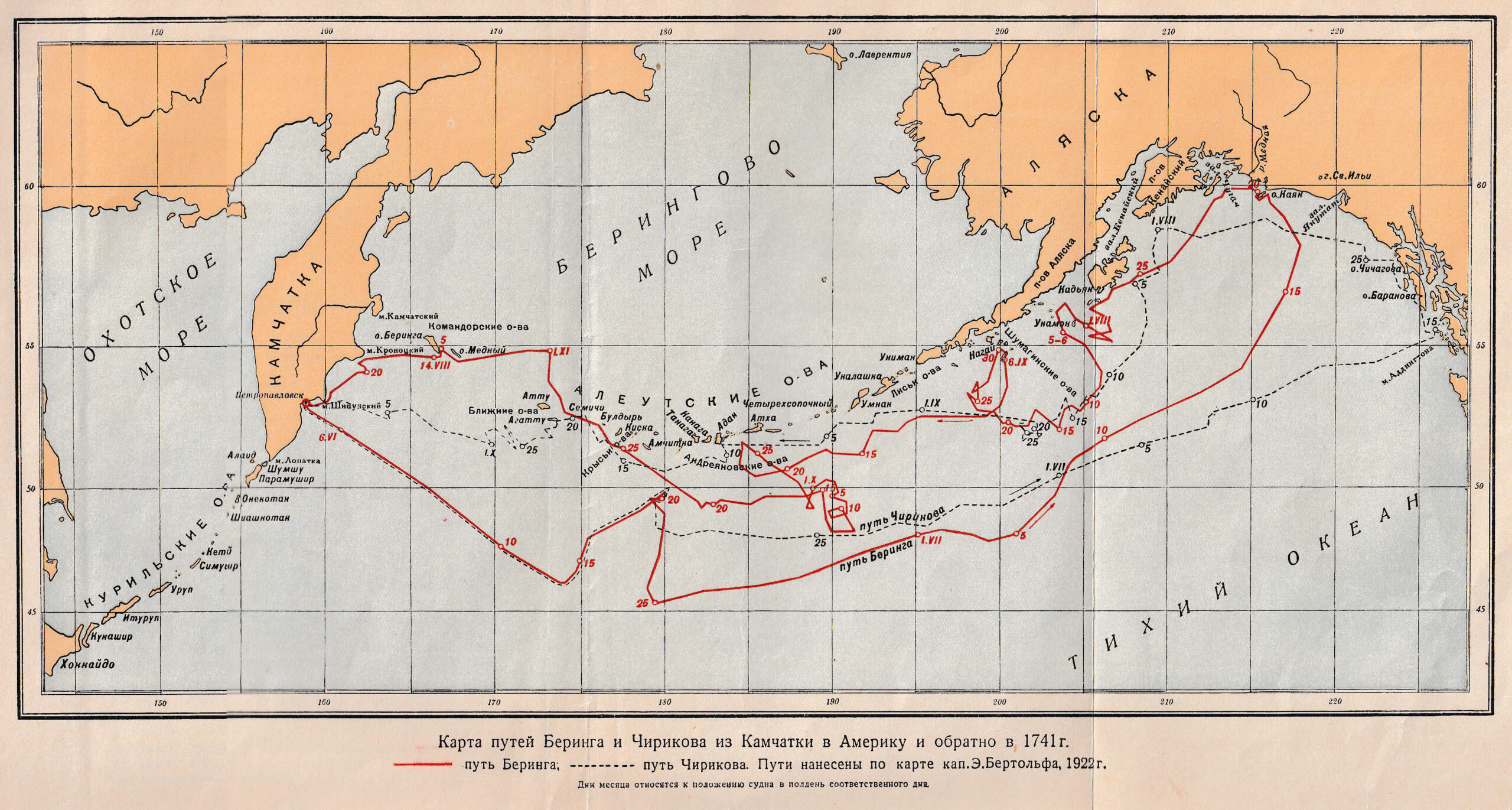
The participants of the Second Kamchatka Expedition included professors and adjutants of the Academy of Sciences.
The participants of the voyage - adjunct of the Academy of Sciences G.V. Steller, captain Alexey Chirikov and naval officer Sven Waxel - collected the first information about the Aleuts.
Steller and Waxel were on the ship "Saint Peter", which reached the coast of America on July 20, 1741, and made a stop near Kayak Island. Here Steller made some explorations, including ethnographic studies, although he did not see the inhabitants. On the way back, the Shumagin Islands were discovered, where the expeditionists met with the Aleuts for the first time. On the map were pictures of animals drawn by the artist of the expedition Friedrich Plenisner, on this map there are images under which are signed: "Sea cow", "Sea cat", "Sea lion or eared seal", "Aleut from the Shumagin Islands with a rod to which two falcon feathers are attached" and the signature "American in a sealskin leather boat". Steller described his observations in detail:

"One of them (of the Aleuts) came quite close to us, but before he came quite close, he reached into his sinus, took out some earth of the color of iron or lead, and made two pears on his cheeks from his nose, and stuffed his nostrils with grass: the wings of his nose were pierced on both sides with thin pieces of bone. Then he took a spruce stick lying behind him on top of a leather boat, painted red, three arses long like a billiard cue. On it he put two falcon's wings, tied them tightly with a whale's whisker, showed them to us, and then, laughing, threw them into the water in the direction of our vessel. He tied a whole falcon to another stick and handed it to our Koryak interpreter".
It was a kind of magical ritual in defense against foreigners.
I.E. Veniaminov noted that at their first meetings the Aleuts took the Russians for supernatural beings. The transfer of harpoons, to one of which were attached the wings of a falcon and to the other its effigy, was a rite of sacrifice.
The next day, September 5, 1741, there was another meeting of the crew of "St. Peter" with the Aleuts, about which G. Steller wrote as follows. Steller wrote as follows: "We again saw nine Americans in boats, who rowed one after another to the ship with the same shouts and ceremonies as the first time. But only two approached our ship; again they handed over presents - sticks with falcon feathers and yellow face paint. On their heads were hats made of tree bark and decorated with red and green spots, resembling in shape the eye visors usually worn on the head; the top of the head was left uncovered, and the hats seemed designed only to protect the eyes from the sun.
When these Americans realized from our many signs that we wanted one of these hats, they even gave us two."
Things received from the Aleuts, unfortunately, were lost during the wintering 1741-1742 years of the crew of the "St. Peter" on the island, which was later named in honor of Vitus Bering. But Lieutenant Sven Vaksel, who led the expedition after Bering's death, sent to the State Admiralty Board only a bone figurine, which was attached to one of the hats, as a confirmation of the meeting with the Aleuts.
The Second Kamchatka Expedition was the beginning of a whole epoch of voyages in the second half of the 18th century of enterprising Russian merchants, seafarers and industrialists to the Aleutian Islands. During the fishing voyages new islands were discovered until the entire Aleutian Islands chain and Alaska became known.
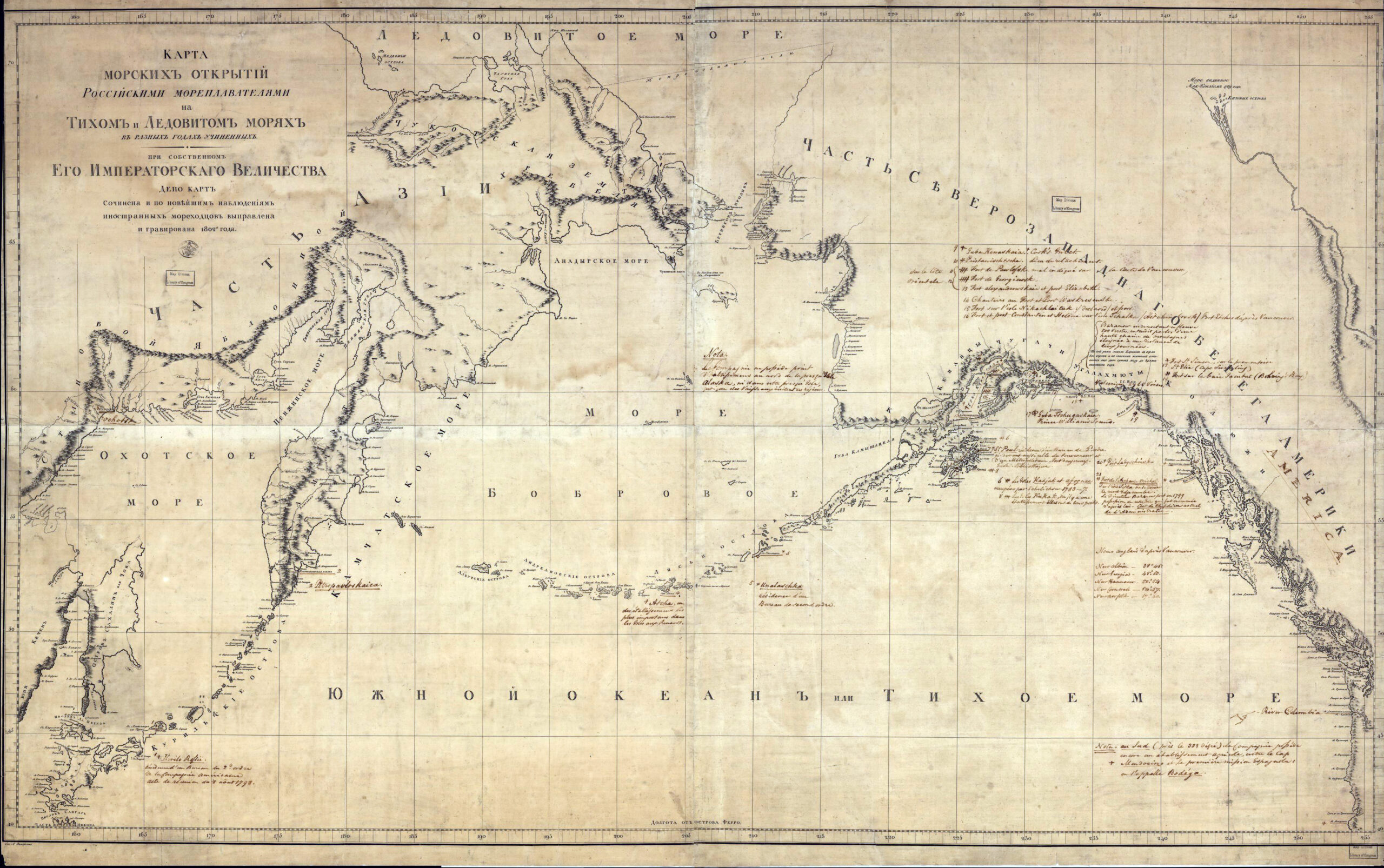
With the establishment of the Russian-American Company (1799-1867), the Aleuts became the main employees of the company - fur and local food producers. The skins of sea beavers were the main subject of export, as they were the most valued type of fur, followed by furs of sea lions, foxes, and Arctic foxes. Hunting beavers at sea required high skill, for which the Aleuts, first called "sea Cossacks" by Innokentiy Veniaminov, were famous. "On the sea during the excitement they always distinguish the fall and speed of the wave and always distinguish a simple excitement with a placer on the clear sea from the excitement on the shoal and submariners, so only the Aleuts can fish beavers in the sea, and Russians, no matter how skilled in kayak riding, can never be beaver industrialists" - wrote Veniaminov about the Aleuts.
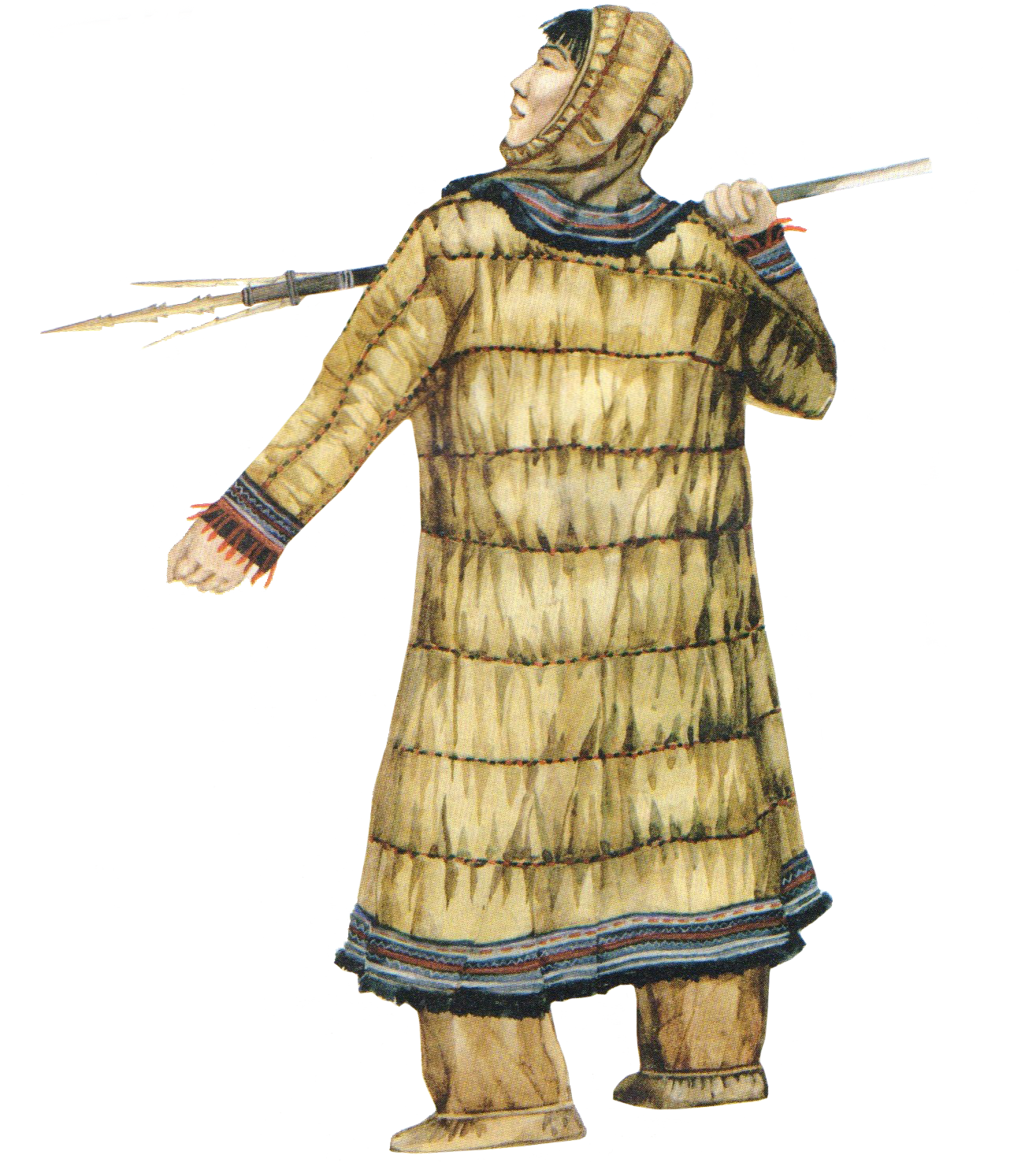
The hunter had to provide his own hunting equipment. Every Aleut could build a canoe, although there were special masters of this craft. Hunters also made "beaver arrows", i.e. harpoons with throwing boards, and spears. Women sewed intestine "kamleikas", bird parkas, torbas, and kayak covers.
According to the company's charter, the Aleuts were sent to fishing at least 15 years old and over 50 years old. But this rule was not observed by the Aleuts themselves: without an old and experienced leader they did not go to sea, and young people were taught to fishing from 11-12 years old, so that they could become skillful hunters. The old fishermen watched over such pupils.
The fishery was of traditional character. The party was divided into groups that surrounded and chased beavers, observing extreme caution and silence not to frighten the animals. Only "beaver shooters" were used, not firearms.
At different times the Aleuts left in groups in kayaks for bird, sea lion, walrus and whale fishing and returned at the end of August. The Aleuts, men, women, and children who remained in the villages were already engaged from May in constructing dams in the rivers for spawning fish, catching them in the sea, and preparing "yukola".
On Bering Island as early as in 1805, the navigator of the brig Konstantin Potapov landed an artel of Russian industrialists of 16 people headed by the kayaker Fyodor Shipitsin to hunt for seals and Arctic foxes. Then the artel moved to Medny Island, leaving Yakov Mynkov to guard the furs. Only after 3.5 years the ship “Finlandia” under the command of I.F. Vasiliev approached Bering Island, but Mynkov was left on it together with other industrialists. Shipitsin reported to the Okhotsk office about sea beavers that appeared again near Medny Island and demanded to send Aleuts for their extraction. But only in 1825 17 Aleuts with their families were sent from Attu, which started the appearance of permanent population on the Commander Islands.
The life of the Aleuts was closely connected with the natural conditions of the islands.
According to early sources, the Aleut economy was based on hunting marine animals, with fishing being an important addition. Waterfowl hunting played a significant role in the household. Gathering in the intertidal zone, gathering edible roots and berries were of secondary importance.
The sea and the seashore served as sources of all necessary means of subsistence for the Aleuts. The skins of sea beavers, northern fur seal, sea calfs, and sea lions were used for clothing, and they were also used as beds. The skins of sea birds were also used for clothing. The skins of sea lions and sea calfs were used for canoes and kayaks. Meat of seabirds, fish, animals and gathering products were used for food, the wood thrown ashore was used to make the basis of dwellings and various products: boat frames, throwing boards, hunting headdresses, household utensils, arrowheads and spearheads were made from the bones of sea animals. The ribs and jaws of large whales were used to build dwellings. The Aleut household cycle was also formed in accordance with the natural cycle.

At the end of April, summer birds arrived and sea animals appeared near the islands - bulls of seals and sea lions, which at this time began to be hunted at sea.
From the end of April, fishing began for fish that entered the rivers from the sea to throw eggs. Fish of different species went until fall.
In May they continued to hunt bull fur seals, seals, sea lions and fish. From May to July, sea beavers were hunted at sea. In June-July, we hunted seals, including females, which appeared near the islands in late May, sea beavers and fish. Bird hunting started in mid-July, when chicks fledged, and continued until September. Seals were hunted in October-November. After the end of the fishery due to cold weather and strong winds in the sea they stopped fishing. Then the Aleuts fed on stocks of seal meat, dried fish, caviar, fat, saran roots, and when they ran out, they collected mollusks in the intertidal zone and sea cabbage.
The traditional way of life is reflected in the calendar of the Aleuts, which was cited in I. Veniaminov's work "Notes on the Islands of the Unalashki Division" (1840). He wrote that each month had its own name associated with the hunting of animals and birds.
The Aleuts started counting the months from March. March was called kisagunak - the time when they ate skin for lack of food.
April is agalyu ʼigikh kisagunak - "the month in which the skin is eaten for the last time. It is the time of arrival of summer birds and the arrival of sea animals, seals, sea lions".
May - chigum tugida - "month of flowers" - time of fishing for sea lions, seals - bulls.
June - chigalilim tugida - "the month of nestlings and newborn sea animals".
July is sadignam tugida - "the month when young animals get fat".
August is ʼukhnam tugida, "the warm month in which the grasses begin to wither". At this time, nestlings are already flying and sea animals' cubs are becoming independent.
September - chnuʼlim tugida - "the month in which the wool of all animals and the plumage of birds become the best".
October is kӣmadgim tugida - "fishing month".
November - kimadgim kangin tugida - "post-fishing month".
December - agalgugak or agalgaluk - "the month in which seals are hunted".
January is tugidigamak - "the big, main month, the time in which the urils (red-faced cormorant) appear".
February - anulgilak - "uriliy month", because at this time, they hunt for urils with snares.
Many industrialists knew crafts, among them were carpenters, shipbuilders, blacksmiths, shoemakers and other craftsmen. All the crafts and arts that the Russians could bring to America, the Aleuts were eagerly recruiting, so that even among the Aleuts one could find craftsmen from a shoemaker to a watchmaker.
LITERATURE:
- Р. G. Lyapunov's “Aleuts” articles of ethnic history.
Leningrad publishing house “Nauka”
Leningrad Branch 1987.
- Р. G. Lyapunov “Essays on the Ethnography of the Aleuts”
Leningrad publishing house “Nauka”
Leningrad Branch 1975.
- И. Veniaminov “Notes on the Islands of the Unalashki Division”. Collected Works Volume 2. Publishing house of the Moscow Patriarchate of the Orthodox Church Moscow 2012.
- Aleuts - Kunstkamera collection catalog. St. Petersburg 2014.
- Photos from the funds of the Aleutian Museum of Local Lore.
Information prepared by the staff of the Aleutian Local History Museum