


Outerwear and underwear
The harsh climate of the Far North requires reliable clothing that can protect against severe frost in winter and wildebeest in summer. Over the centuries of living in harsh northern conditions, the Nenets have learned to make unique clothes that best preserve warmth and protect against wind, snow, rain and frost.
Nenets clothing is divided into men's and women's. Traditional men's winter clothing consists of a raspberry, a pim, fur trousers, a belt, finches, a scoop, a belt and a hat. The malitsa is a knee-length, deaf men's outerwear made of deerskins sewn with furs inside. A hood with ties is sewn to the neck of the shirt, and mittens are sewn to the sleeves. The raspberry is tied with a belt. To protect the mezdra, a cotton shirt is worn over the malitsa and belted with a rawhide belt decorated with copper lace plaques or buttons. In cold weather, a 'sovik' is worn over a raspberry, which is also a blind outer garment, but it is sewn with fur outside, the hood is trimmed with fur, and there are no sewn mittens. The sovic is worn without a belt.
Women's winter clothing includes a 'yagushka', 'pims', fur trousers, a belt, finches and a hat. The yagushka differs from the men's raspberry only in the front slit and rich trim. They decorate women's clothing with appliques of pieces of leather and colored suede, stitching individual elements so that a characteristic ornament is obtained. Also, the bottom of the sleeves, the edges of the hood, and headdresses were lined with furry animals.
Summer clothes were rarely sewn on purpose, usually they were worn winter clothes without lining, which had much worn fur. With the arrival of the Russians and the development of trade, summer clothes began to be sewn from cloth.
Nenets shoes are usually sewn high, up to the groin, such shoes are called 'pims'. Pima\s are sewn from skins taken from the feet of deer, it takes about ten skins to sew men's pims, and eight to sew women's ones. Women's shoes differ from men's shoes in their cut. For ease of wearing, pims are tied with straps under the knees and secured with straps to rings sewn on fur trousers. Under the pims, 'chyzhy' are worn – fur stockings up to the groin, women's chyzy are shorter than men's.
For small children, they sewed clothes like overalls made of soft reindeer skins.
Men's clothing
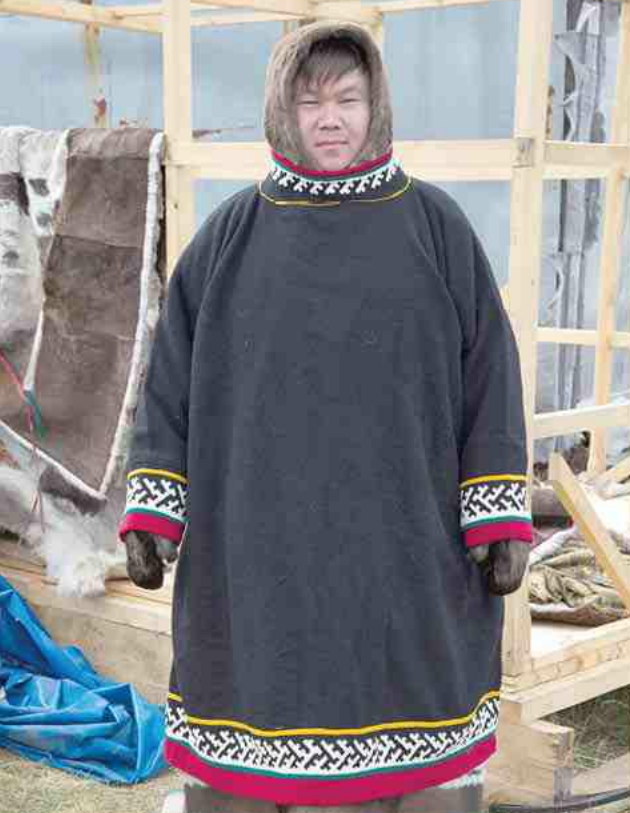
Nenets men's and women's clothing differ from each other in appearance and cutting technology.
The basic clothing of reindeer herders who lead a nomadic lifestyle includes a 'sokuy' jacket and 'bokari' shoes. The malitsa is the only casual clothing the Nenets have. It is worn with fur inside. A malitsa is a wide garment with a hat and mittens sewn to it. Length is below the knees. A hood can be easily removed from the head and tilted back if necessary. Cut of the malitsa is quite wide. Front and back are sewn from single pieces of hide, they are slightly flared downwards. Sleeves expand to the armholes. Mittens made of camus (skin from deer's feet) are sewn to ends of the sleeves with a fur facing out. Upper part of camus is used for the back wall of the glove: the pile is longer there. And for front, from the bottom, where the pile is stronger. A rectangle measuring 10 by 15 cm is sewn to the mouth of the sleeves, in the brush area. A gap is formed between the glove and the rectangle, through which the hand passes freely. The Nenets people even have such a riddle about the male malitsa: "You go in one hole, you come out of three."
Hood of the malitsa is sewn using the technology of a bonnet, and it is sewn from black summer fur. With the help of a threaded ribbon, you can expand or narrow the hole framing the face. A narrow strip of cloth is first sewn to the bottom of the scarlet, then a 45 cm wide strip of summer deer skin is attached with the fur facing out. This part is called 'panda', which means 'hem' in Nenets. Strips of multicolored cloth, as well as white and black fur, are sewn at the junction of the upper part of the raspberry and the panda to make the clothes look more beautiful. A "'maltsya tanga' is put on top of the malitsa, which is a cover made of beautiful cloth or fine cloth that protects the skin of the skins (the lower layer) from dampness and dirt. In October, three fawns are slaughtered to sew such raspberries.
The malitsa is belted with a beaded or leather belt decorated with brass buttons and plaques of various shapes. A belt for the Nenets is a symbol of dignity and bravery. A scabbard is attached to it on copper chains. A suede grindstone case and bear fang charms on chains are sewn to the lower part of the belt. Leather belts are decorated with brass buttons and various pendants.
In frost and blizzard, men wear 'sokuy' ('sovik-sook') on top of malitsa, which is not much different in its cut from a malitsa. These are knee-length, blind, slit-free clothes. It is much longer and wider than a malitsa. The occipital part of the 'sokuy' is cut together with the hood, and the mittens are not sewn to it. A fringe of arctic fox tails or thick-haired white deer fur is attached to the edge of the hood. This is the 'sebya var' – edge of a hood. A hem made of white deer fur, 'sook ngeso', is sewn to the bottom of the sovik. They put on a sovik with the fur out and do not gird it. A sovik made of white or mottled deer fur is an elegant, festive clothing of the Nenets. Sokuy is street clothes, it is never brought into the chum. It is decorated with tassels made of long strips of colored cloth with strips of fur sewn on them. In case of unforeseen stops on the way, the sokuy serves as a sleeping bag for the prudent Nenets. They lie down on the snow in it. It takes four skins of six-month-old fawns to make these clothes, and one skin of an adult deer is spent on the hem.

Men's trousers, fur – winter outerwear, which was sewn from wadding (calf skins under the age of one month) or calf flanks with fur to the body. Previously, they were always sewn from the skin of a horus or a bull (i.e., a male deer). A short-haired hide is used to make fur trousers. Upper part of the pants does not have a slit, they are supported at the waist by means of an overstretch from the waistband. Sometimes the strap is simply sewn on and tied. Sewn like natazniki, the trousers in the lower part have extensions in the form of trousers that go down well below the knee and are tucked into fur stockings. Two straps (often with rings) are lowered from the belt, to which shoes are tied. In summer, trousers are sewn from rovduga (suede) or purchased knitted underwear is worn.

The men's hat is a traditional fur headdress. There are several types of men's hats: simple, elegant and formal. Simple hats were sewn without decorations. They were intended for permanent wear. They were worn by men, teenage boys, and young men. According to the cut, men's hats were sewn slightly wider up and lower than women's hats. The children wore the same hats, but smaller. Depending on the age of the child.
Ceremonial cylindrical hats were intended only for men and were of two types: the usual one in the form of a cylinder; narrow strips of cloth of three traditional colors (red, yellow, blue or green) were sewn on top of the side seams and around the bottom as wide as the index finger.
The second type of men's ceremonial hat is a hat with a round (cylindrical) bottom and elongated decorated ears ("with the legs of the hat"), with stitches of strips of white or dark fur and cloth of different colors. When worn, these ears, fastened with a copper chain, recline back. The front and occipital parts of the cap are cut out of whole pieces, and the front of the product may be higher. Such ceremonial hats were usually worn by middle-aged and sometimes older men. And for boys and young men, they sewed hats in the form of a top hat with long ears made of white wadding. In the traditions of the Nenets, white fur gave the hat and all the clothes a parade and solemnity.
The difference between men's hats and women's hats is in the arrangement of cloth ornaments. Cloth stripes on men's hats are sewn along the seam in a circle (if the hat has short ears, then along the side seams). Nenets men take great care of their hats. They keep their fancy hats in sacks, and those that were worn every day after entering the chum. They tied the chum to the pole by the straps or pushed it behind the six. In short, they tried not to throw the hat and put it in a higher place. Guests who came for a short time did not take off their hats or held them on their laps.
Woman's clothing
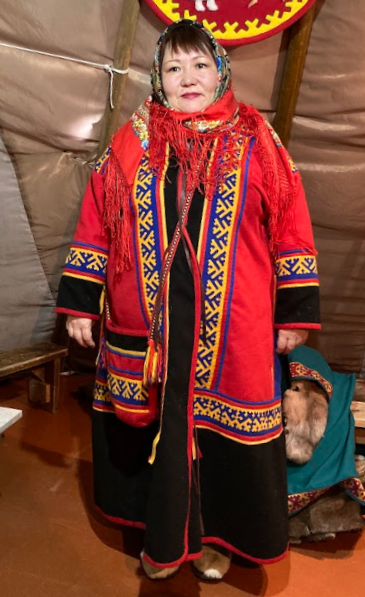
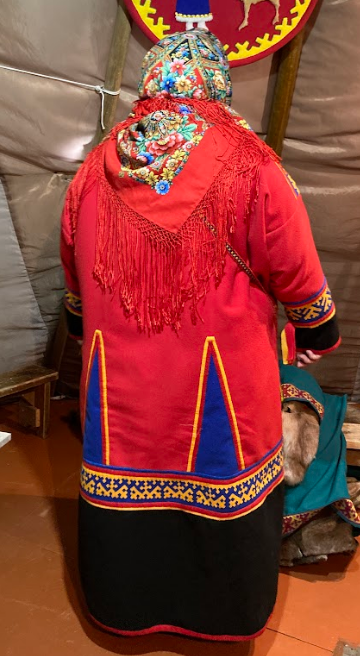
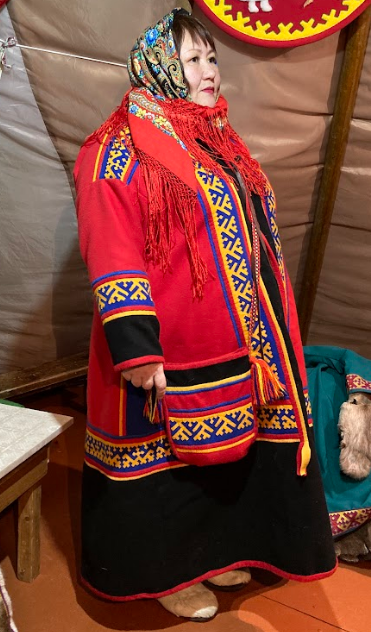
The Nenets woman spends most of her time in the chum. Elegant and warm women's clothes are usually kept in cargo sleds, they are taken out from there before moving to another place or before a long journey to visit or for fuel. The women's clothing set includes a swinging double fur winter parka – 'pany', 'bokari' and a hat. The women's parka differs from the men's parka in appearance and cut. It takes five reindeer skins. The women's parka is hinged, sewn with fur up and down. The upper part is made of calf skins with a smooth pile. Camus mittens and a fox collar are sewn to it. A parka made of white or mottled skins is considered elegant. A wide strip of dark fur is sewn along the hem of the parka. The edges and hem of the parka are wrapped with narrow strips of cloth, the same strip is attached to the shoulder seams. A lining made of deer, arctic fox or rabbit skins is sewn inside the park. The parka is decorated with ornamental stripes made in the technique of fur mosaic made of dark and white camus. Its straight floors converge, but are not wrapped, but are tied with suede or cloth straps. Short straight sleeves with a gusset taper to the cuff. Shawls, multicolored shawls, and belts woven from multicolored threads serve as a beautiful addition to the park. Such clothes are designed for long-distance trips, sleeping, chopping firewood, for holidays and weekdays.

Women's trousers, fur – winter undergarments made of short-haired, well-tanned skins of adult deer with fur inside. They have adjustable pant legs that descend slightly below the knees. The lower parts of the trousers were tucked into fur stockings, which in turn were tucked into the tops of the shoes. At the waist, the pants are supported by a suede strap sewn to their upper part. Two rings for tying shoes were attached to this strap. In the eastern regions of Yamal, the Nenets women's trousers had a sewn-on bib, which was a strip of fur or a bow from the waist to the neck. It had two adjustable straps at the top, which were tied at the back of the neck. The presence of a bib is explained by the fact that there were swing clothes in harsh winter conditions. In summer, Nenets women wear rainbow trousers, similar in cut to winter ones. Nowadays, cloth or knitted underwear is often worn instead.
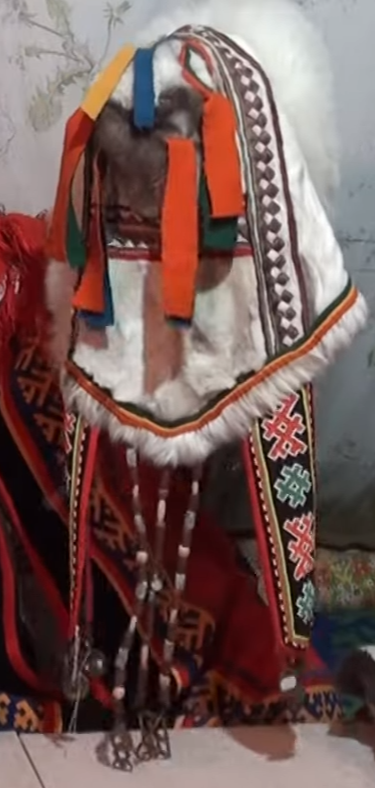
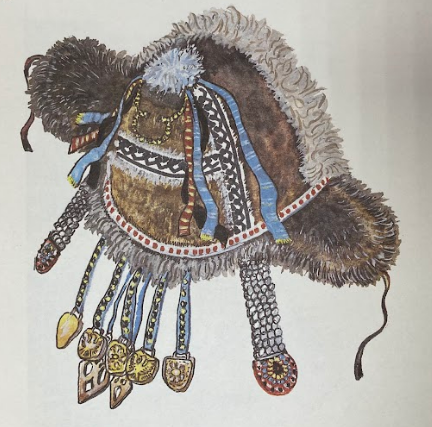 A women's hat is a headdress of a Nenets woman, which is a natural addition to 'yagushki'. There are several types of caps.

Older women wear high caps made of wadding with a round bottom and short ears, the same cut as men's. The lining is sewn from calfskin. Elegant hats of this type are trimmed with cloth: square or triangular pieces of cloth of different colors (6-7 cm long, 2-4 cm wide) are inserted at some distance from each other along the seams of the cap – around the bottom and along the side seams. The ends of the strips hang freely at the same time.
Two long stripes of camus (8 cm wide) are sewn to the back of the hat, richly decorated with mosaic ornaments of a combination of white and dark fur and cloth inserts. In the middle, the ears of the cap are connected by copper chains or threads.
Another type of women's hat is mostly worn by young women and teenage girls. This headdress is a high semicircular hat, sewn from two pieces of fur (wadding), without a bottom, with short ears sewn on. Front of the cap is slightly higher. The lining is sewn from the abdominal part of the deer skin, it is similar in cut to the top. But the ears are not sewn on, but are cut from one piece (in case of a shortage of material, extensions are simply made in different places). Strips of cloth are inserted along the seam, which runs in a semicircle from one side to the other through the top, the same as in the first type, at some distance from each other. Ears are sewn to the back of the hat. Presence of ears on a hat usually indicates that it belongs to festive fancy clothes. The ears of the hat are not tucked into the belt. And they hang freely over the yagushka, falling below the waist.
There are also waddy hats sewn from four cone-shaped pieces that converge on the crown and have long ears. Ends of the ears can be decorated with camus ornaments and hooves of newborn calves. To make the cap hold on tightly, ribbons or ribbons are sewn near the base of the ears in front, which are tied under the chin. In some areas of Yamal, an unusually beautiful bonnet with a lush fringe of arctic fox tails or white deer fur is widespread as a women's headdress. Hats of this type consist of three parts – the central part – a long strip that goes through the crown to the ears; the occipital part, which is always sewn from a deer's forehead, and the eye sockets are sewn with pieces of fur edged with colored cloth (and the side details are cut out so that the direction of the fur is from top to bottom, they are a triangle in the upper part is 4-5 cm, and the lower part is up to 22 cm), the place of the horns on the skin is closed with cloth tassels, and the back part, which descends in a semicircle onto the back. These parts are separated by stripes of a pattern of white and dark fur, which are a solid geometric pattern made in the technique of fur mosaic. Along the front part, a fringe is sewn, on which up to five arctic fox tails go.
A large number of copper and iron ornaments with a slotted and embossed pattern, connected to each other with a narrow strap, and large beads are sewn to the back of the lower edge of the cap. These ornaments pull wings of the hat back, pressing them against the fur coat, so that cold air does not get under the fur. When walking, the suspensions emit a light chime. In front, under the chin, the hat is tied with the help of adjustable straps.
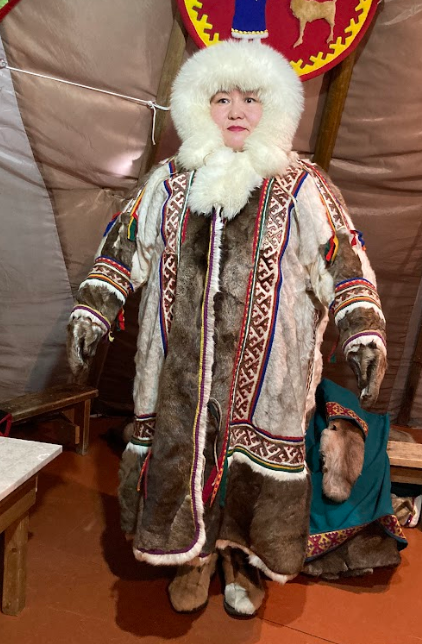
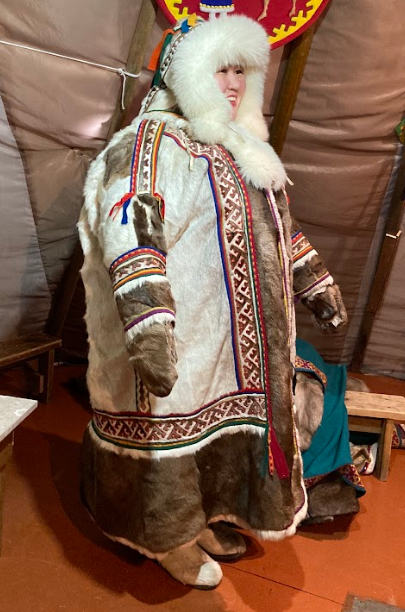
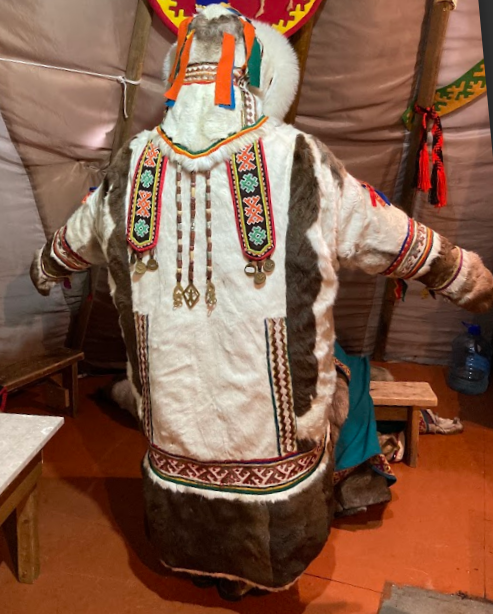
Festive clothes differed from everyday ones in the abundance of jewelry and fur applications (for women) and color (white or dark soviks for men, pims made of variegated camus, etc.). Clothing, especially for women, was decorated with inserts of wide horizontal and vertical stripes of colored fur, fur applications of white and black fur, less often strips of colored cloth, sewn at one end to the clothes (for example, to the bag). Purchased metal jewelry (patterned bronze plaques, bells, bells), beads, and rarely beads were widely distributed. Men often cut their hair into a circle, less often grew it and braided it into two pigtails. The women parted their hair in the middle and braided it into two braids, sometimes elongated by false braids made of strips of colored cloth and woolen laces with brass jingling ornaments attached to them. A beaded 'sudyr' headband with metal chains suspended from it was common among women.
The clothes of children under the age of 3-4 consisted of a fur jumpsuit (with fur inside), 'parkas' — clothes of the same cut as a malitsa, but double (with fur inside and out) and fur boots, which differed little from the stockings of adults. From the age of 5-6, children usually wore clothes that were almost indistinguishable from the clothes of adults. The headdress was sewn to the clothes, as children do not like to dress for a long time. Infants were placed in wooden bunks, covered with a fur blanket. All fur clothing (and often cloth) was sewn with threads from the back and leg tendons of deer. The rich men's malitsas were made of deer skins, well matched in color, often with an otter fur hood. The women's 'panitsa' had a fringe of fox and otter fur, and the collars were made of arctic fox tails.
To instill in children the idea of how their clothes are arranged, parents taught their children to sew clothes for their toys. The toys consist of the beaks of ducks, geese and other birds, to which clothes are sewn.
Footwear
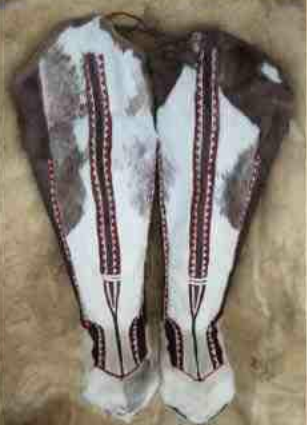
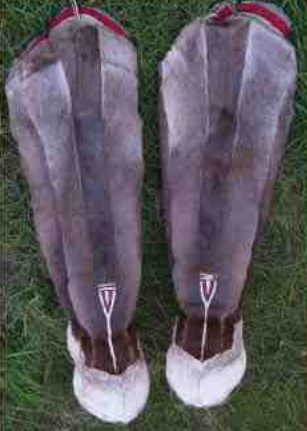 Women's bakariare Nenets national fur shoes, which Nenets women sew themselves. Very comfortable when walking for a long time, warm and light shoes. The shoe consists of a stocking sewn with fur inside and a lower part made of camus with fur outside. About eight camuses are spent on women's bakari. The cut of women's bakaris is somewhat different from the cut of men's ones: the front stripe of the camus is much narrower and ends with a narrow toe, not reaching the toe. The pattern is also made much lower – at the very toe. Perhaps this is due to the fact that women's clothing is longer than men's and the pattern is made lower so that it is visible.
According to these signs, female bakari can always be distinguished from male bakari. In addition, women's shoes never have soles made of deer foreheads (but only from brushes), which is a relic of the idea that women's shoes are "unclean". Women usually did not wear sealskin pims (the seal was considered a sacred animal). Unlike men's pims, women's ones are tied only with belts to the waist and are never tied under the knee. In addition to the pattern on the front toe, a pattern of stripes of light and dark tones of fur and cloth is made from the side, limiting part of the pimples, and from behind – above the heel. It is considered a great skill to sew seven such strips. White pims are considered beautiful. To decorate the pims, applique, coloring or scraping is used. It all depends on the skill and taste of the woman who makes these shoes. The craftswoman has her own approach to each type of material. Women bakari are often decorated with a diamond–shaped pattern - "firebrands", "calf horns", and girls' bakari have a pattern of "rabbit ears", which indicates that the shoes belong to a girl who is shy like a rabbit. Currently, tassels have been added to the fur ornaments of products, including bakari. This makes the pattern clearer and brighter. In addition, the strips of fur and cloth adorning shoes indicate prohibitions: you can not steal, you can not kill, you can not swear, you can not offend the weak, and the strip that goes to the toe of the shoe indicates the line of life. A special bag ('shuipaty') made of suede is sewn to store women's shoes. The shoe storage bag and the women's shoes themselves are stored on a special sled, separate from other things. This is due to the Nenets idea of the ability of a woman, or rather, her step and, accordingly, her feet and shoes, to "communicate" with the forces of the Lower World (this is stated in many Nenets legends).

Men bakari are Nenets national shoes, which are sewn from ten camus of autumn deer. Bakari's seams are internal, that is, along the wool. The sole is sewn from brushes from the deer's feet, taken from the sole of the deer's foot, or 'tay' skins from the deer's head, while a pile on the sole is directed backwards. Under the bakari, 'toback' finches are sewn from autumn skins of young deer or rabbit skins, sewn with cloth. Nenets man has 2-3 pairs of such shoes. They used for sewing bakari, deer veins or purchased durable threads. Men's bakari are significantly different in cut and pattern from women's bakaris. They are decorated in front with transverse fur stripes, between which narrow cloth ribbons of red, blue, and green are laid. On men's bakari, such transverse stripes are usually located below the knee.
Ornaments such as 'deer trail', 'moose horns', 'man's head', 'chumiki', 'bear ears', etc. are used on men's bakari. When making the ornament, white and dark fur is taken, folded with fur inside. After cutting, the fur is sewn from the wrong side butt-to-butt and turned out. Such shoes are tied with special straps to the rings on the belt of fur trousers, and, in addition, they are tied under the knee with a strap or cord woven from purchased dyed wool or woolen threads in a jacquard manner. Garters are 1.5 – 2 meters long and 2-3 cm wide. Nenets take great care of shoes, each pair of shoes even has its own name. Nenets wear bakari for 5-7 years or more, every man necessarily has 2-3 pairs that can be inherited or "carried away" with him to the lower world, there are also weekend or holiday bakari that can serve a lifetime.

Belt 'ni”, “ni’ inya' these festive belts are woven from beads using various ornaments and bright colors in the right combination. In everyday life, strong belts made of leather with a metal plaque made of brass are used. On the belt in front, on the left side (if the man is left–handed, then on the right side), a scabbard with a man's hunting knife is rounded off, and on the right side there is a knife sharpener and a suede bag for gunpowder and tobacco. Nenets people believe that only lazy, sloppy people go without belts.
Women belt is an obligatory important attribute of the traditional dress of the Nenets woman. There are winter and summer belts. The winter belt was self-woven, it is woven from dyed wool in different colors. A copper buckle shaped like a ring with a diameter of up to 20 cm is sewn closer to one of the ends. At the buckle level, the belt is folded in half. After girdling the waist, the longer end is threaded into the ring in front, and both ends are tied together. In the past, women's belt buckles reached a significant size (up to 3-4 meters in length) and weight. This was given hygienic and magical significance.
The hygienic value of the belt lies in the fact that it supports the press and protects a woman from certain diseases, and the belt also helps to keep warm all day. In addition, metal, in particular, the belt buckle, is perceived by the Nenets as a symbol of purity.
Sources:
- Ornament is a language of the ancestors / V.I. Batagai [et al.]; ed. by V.G. Zavarzina [et al.]. Dudinka: [B.I.], 2020. 156 p. URL: https://www.tdnt.org/pdf_poli.php?id=41&t=publ
- The informant is Yaptune Rosa Yankovna, a native speaker of Nenets culture and language, a well–known journalist of Taimyr Radio, a member of the May'ma club.
- The informant is Anna Pavlovna Yarotskaya, a Nenets costume designer at the Taimyr House of Folk Art.